This is default featured slide 1 title

Go to Blogger edit html and find these sentences.Now replace these sentences with your own descriptions.

This is default featured slide 2 title

Go to Blogger edit html and find these sentences.Now replace these sentences with your own descriptions.

This is default featured slide 3 title

Go to Blogger edit html and find these sentences.Now replace these sentences with your own descriptions.

This is default featured slide 4 title

Go to Blogger edit html and find these sentences.Now replace these sentences with your own descriptions.

This is default featured slide 5 title

Go to Blogger edit html and find these sentences.Now replace these sentences with your own descriptions.

Showing posts with label systems. Show all posts

Build Or Buy? Five Sub-$500 Store-Bought Systems Compared

Have you ever claimed you could build a faster machine than top-tier vendors, but needed proof? We dig into five off-the-shelf sub-$500 configurations to figure out what they can and cannot do. The results probably won't surprise Tom's Hardware regulars.

Occasionally, someone asks us to recommend a desktop gaming system. A pre-built gaming system. That tends to catch us off-guard because it cuts against our natural instinct as enthusiasts who construct platforms piece by piece. We're always on the hunt for better performance, but that means we need the freedom to pick and choose parts that work well together. When you buy a pre-built system, you largely give up customization in favor of convenience (or, at the very least, a price premium).

To be fair, there are some benefits to buying a system built by someone else. There’s a certain attraction to not getting your hands dirty, and there's no arguing that the price tags you see at retail stores have been dropping in recent years. However, buying a system, even at today’s discounted prices, doesn’t necessarily mean you’re getting the most out of your money. Cheap isn’t the same thing as value. A computer’s worth is just as much about performance as it is about cost.

March 2011 Gaming PC

It doesn’t take a lot of effort to buy a pre-built machine. You only need two minutes, a credit card, and a device with Internet access. Building requires significantly more effort: time spent shopping for each part, plus you need to know which component combinations deliver the best experience. And then there's the build process itself. Generally that goes well, but we'll all had our share of run-ins with compatibility issues and hardware that lands dead on arrival.

Really, this is what separates the enthusiast willing to do some homework and his mom or dad, who oftentimes don't have the patience, time, or interest to learn what cards plug into what slots. There's an in-between approach, too. Buy a complete system for convenience's sake, and as it gets older add upgrades here and there to suit. Is that any more worthwhile for keeping a machine gaming-worthy?

Today we're pitting building against buying in the entry-level space in order to gauge the difference. We gave ourselves a $500 budget and bought five pre-configured desktop PCs in our quest for cheap performance. Using our recent $500 Gaming PC as a reference point, we're curious to see how five builders measure up to the configuration picked by Tom's Hardware writer Paul Henningsen.


View the original article here

Silverstone FT02


Silverstone has been making first-class PC enclosures since the company was founded back in 2003, and the FT02 is no exception. Borrowing an interesting design element from Silverstone’s unique Raven
RV01, the Silverstone FT02 is the only case in the roundup to feature a 90-degree motherboard mounting design that literally turns the internals of a system on its side. With the FT02, the motherboard mounts to the chassis in such a way that its I/O panel sits at the top of the case, where cables can be connected and hidden by a panel along the top. Assembling a system inside the FT02 can seem a little weird at first, but there’s really nothing too unusual to consider once the mobo is mounted.
The Silverstone FT02 has very clean lines, with curved corners that are easy on the eyes. Build quality and attention to detail are excellent. The case even has sound-dampening material on its side panels to minimize vibration noise. At $239, the FT02 is one of the more expensive offerings in the group, but this case is worth the investment. It’s relatively quiet, performs well, and looks great.

Two Entirely Different miniature PCs / PeeWee PC

PeeWee PC


For example parents, we cringe all point our kids treatment our laptop. PeeWee PC’s PeeWee Pivot 2.0
Can help tame our nerves. Not merely does the $599 netbook-looking Pivot 2.0 Mark Windows 7, 15 learning titles, and an Intel Atom N450, but it as well sports such skin As a 180-degree rotating touchscreen, water-resistant upright, non-slip grips, relentlessly plastic outside, and two Security suites. Taking the “peewee” theme to the adult level is the fascinating Xi3 Modular Computer whose aluminum sides amount fewer than 4 inches Each one. The Xi3 needs fewer than 20W to run, comes in 10 color options, and provisions six USB 2.0 and two eSATA ports; DVI, VGA, and HDMI; a fine Of three AMD CPUs (including 2.2GHz Athlon 64 4200+); up to 4GB DDR3 RAM; and 1080p playback. Perhaps largely alluring are the rig’s three Swappable boards, counting individual to facilitate contains the CPU, graphics cut, and RAM and an additional with tape, input, and USB acquaintances. “We deny the Hypothesis to facilitate computers must take a functional life of merely two to four years,” says Xi3 boss Jason A. Sullivan. Sans input strategy, the Xi3 starts on $849 with Linux Suse built-in.

Thermaltake Armor A60

Thermaltake has expanded its midtower Armor series with the Armor A60, a practical and durable case with USB 3.0 connectivity. What makes the Armor A60 a builder-friendly enclosure is the externally
accessible SideClick EasySwap 3.5 HDD bay and support for up to seven fans. The left side panel includes a 3.5-inch HDD bay with a spring-loaded cover that houses one of six 3.5-inch HDD drawers (these are also compatible with 2.5-inch drives) and acts as a hot-swap bay (that is, if you’re running in AHCI mode). The front of each HDD drawer is protected by two flexible plastic arms that should probably be a bit more pliable because we inconveniently snapped one off when we were experimenting with the SideClick EasySwap drawer.
When considering the number of drive cages and fans, as well as the case’s form factor, it’s possible that a deckedout build could get slightly cramped. We recommend using a modular PSU, especially if you plan to install multiple cards and hard drives. The all-black paint job might cause you to overlook some of the significant practical features Thermaltake has incorporated. Some examples are the detachable PSU filter on the A60’s bottom panel, two holes reserved for liquid-cooling tubes, and an external security lock
(held in place with an interior tool-less screw) for the keyboard and mouse. There is also tool-less mounting on the 5.25-inch drive bays. Even though the Armor A60 will accommodate video cards up to 12 inches long, as well as heatsinks up to 180mm high, from the outside it may not impress you or any curious onlooker. You can buy the Armor A60 for its functionality and call it good.

Sony Puts The Walkman Out To Pasture


Although early rumors stemming from a Microsoft Netherlands press release surfacing in mid-October
point toward a Windows 8 release in 2012, Microsoft has plenty to celebrateright now with Windows 7.
According to an Oct. 21 release fromMicrosoft commemorating Windows 7’s first birthday, Microsoft has sold 240 million-plus copies of Windows 7 in the OS’ first year. Reportedly, 65 million sales came in the last 90 days. Microsoft claims Windows 7 has secured more than 17% of the global OS market in less than a year and touts that 1.2 billion PCs globally run a Windows OS. Further, Microsoft says 93% of new consumer PCs run Windows 7 and also points to a 94% customer satisfaction rating (provided by Lifehacker). Business-wise, Microsoft says 90% of companies have already moved or are starting to move to Windows 7.

Alienware M 11 x

The AJienware M IIx isn't your typical gaming notebook. Whereas most so­called mobile gaming machines are rela­tively large and heavy and packed with battery-crushing hardware, the Alienware Mllx has an ultraportable form factor, weighs in at only 4.5 pounds, and is Out­fitted with a balanced mix of components that offers not only strong performance but also excellent mobility.

The machine is built around an 11.6- inch LED-backlit LCD, and it's appoint­ed with a slick, backlit

keyboard. A logo underneath the screen, an "Alien head" power switch, and a couple of accents at the front of the machine are backlit, as well-all customizable using Alienware's included AlienFX application.


The M 11x's build quality is top-notch. It features a sturdy metal shell, and the keyboard area has minimal Rex (if any at all). The touchpad/wrist rest area has a tex­tured matte finish that's comfortable and resistant to fingerprints, which keep the machine looking clean. The glossy screen, however, attracts flngerprin ts galore.

Using the Alienware M II x was an ab­solute pleasure.

the screen is very good (although not great), and the machine's form factor is large enough to allow for a near full-sized keyboard. Battery life is excellent for a machine with this much horsepower, and performance was sur­prisingly good. Gaming ar the panel's native resolution is a cinch for the vid­ia mobile GPU, even when using high­quality settings.

Aerocool Ox - 2000

Compacr cases are sweet. Thanks ro some tasty microATX boards, we know that a small form-factor chassis won't limit us on performance. And if said chassis likewise doesn't limit us to low-pro­file graphics adapters and HTPC-style power supplies, that's like having our cake and eating it, too. Aerocool's debut cube case is the Qx- 2000, part of the company's PGS Q Series. It features four full-heighr expansion slots, about 11.8 inches of room for a longer graphics card, and enough clearance for a standard PSU no longer than 5.5 inches (not included). Aerocool does warn, how­ever, that if you have a modular power supply that approaches this length limit, the hard drive cage might interfere with its cable connectors.


Unlock the Qx-2000's upper Story, and you can lifi: it up on a pair of hinges for unfettered access to the motherboard platform below. The mainboard shares the ground floor wi rh the floppy drive, while the upper level hosts the power supply and drives. TIle Boor underneath the PSU is perforated for borrornfacing funs, but we would CUt a hole here for better air­flow and quieter acoustics.

On the front panel, the chunky pOrt­hole with a domed speaker grille actually houses a 120mm fan. It's the Qx-2000's sole included blower, although you'll get cutouts for three 80mm exhausts and a


GOmm intake should you wish to upgrade. Styled buttons on the fascia let you regulate the fun speed and change its LED color (red, blue, or off). Despite its funny car design and light weight, when dosed, the chassis feels quite sturdy. In contrast, the faceplate plastic is a little thin and has a good deal of Bex to it.

We do wish that Aerocool wOLJd have drilled a few more holes to accommodate 2.5-inch drives including SSDs. Still, for the Qx-2000's fair price, we wOLJd be will­ing to make the necessary drive suPPOrt and cooling modifications ourselves .•••

NZXT Phantom

The NZXT Phantom is a full-tower design that will be available in white, black, or red. Also note that the chosen color covers both the exterior and interior of the case. The Phantom has what I'd call an angular design: The front panel has a triangular protrusion at the bottom, with smoother curves up top. The case panels are littered with angular cutouts and metal-mesh perforations.

At the top of the Phantom, users will find a typical assortment of connectors, along with an excellent five-channel fan controller. The front of the Phantom has a hinged door that hides five 5.25-inch bays, and the back has all of the com­mon elements of a full tower, 


in addition to a switch that gives users the ability to toggle any case lighting on and off. The Phantom includes an array of fans ranging in size from 120 to 200mm. Even with the fans running at their top speeds, the case remains relative­ly quiet.

Because of its size and nearly tool-less design, working within the Phantom is a breeze. All drives, with the exception of 2.5-inch SSDs, which require a few screws, can be mounted using tool-less retention mechanisms or trays. Large graphics cards will fit in the Phantom easily, as will tall, tower-type CPU coolers (provided the optional 200mm side-panel fan isn't installed).

iBuyPower Level 10

magine filling Thermaltake's Level 10 case with today's highest-performing components, setting up RAID config­ urations, and adding all the connectivity features you can think of. The result is iBuyPower's Level 10 dream PC submis­sion. iBuyPower tells us that the Level 10' s cooling capabilities allowed them to produce a system built for long-term reli­ability, stability, and quality.

The compartmental design of the Level 10 case makes it a very quiet system; iBuyPower further lowered noise levels by installing Enermax fans with high-perfor­mance magnetic bearings. The iBuyPower Level 10 was nearly silent, even during our intensive gaming benchmarks. There's not much glitz on the outside of the case, but inclusion of Creative's Sound Blaster X-Fi Titanium Fatall ty Champion Series sound controller and a 12-in-l memory card reader draw your attention to the top compartment. Since all the components are hidden in com­partments, there's no need for any fancy lighting. To make the interior clean, iBuyPower replaced the system's visible power cables with extensions made of individually wrapped wires. The all-black, mesh-sheathed cables add a touch of class to the inside of the case.

Inside the motherboard compartment, iBuyPower installed an Intel Core i7­980X. For graphics power, the Level 10 sent to us featured dual ATI Radeon HD 5970s in CrossFire. iBuyPower shipped the cards in a separate box to keep them safe during the shipping process. Power users will also appreciate the 12GB of Kingston HyperX DDR3-1600 memory, and an OS drive that consists of two 128GB Kingston SSDNow! VSeries in RAID O. Your personal data can be stored on the two 2TB Seagate Barracudas that are set up in RAID 1 to provide redun­dancy. A 1,200-watt Thermaltake power supply and lOX BD-ROMIDVD burner combo drive round out the system.


The lack of a CPU overclock, due to iBuyPower's focus on reliability, and  the inclusion of Radeon HD5970s as opposed to GTX 480s in 3-way SLI, put the Level 10 benchmarks behind many of the Tier II dream PCs. That being said, the Level 10 comes in around $500 to $1,000 less than most of the competition. One test where the Level 10 excelled was 3DMark Vantage, where it delivered an overall score of 24736, a GPU score of 24348, and a CPU score of 35480. The Level 10 also produced an impressive speed of 333.12MBps in the Sandra 2010's Physical Disk test.

We have no doubt that iBuyPower's Level lOis a well-designed build, but we'd have liked to see iBuyPower cus­tomize the exterior of the PC to match the quality parts hidden inside. Imagine how imposing the Level 10 would look with some artwork on the side panels or a clear panel that shows off its high-end components.

Nevertheless, the focus on reliability and stability is something that people wanting a well-rounded gaming machine should take into consideration

The Mac Pro Upgrades

Apple's desktop workstation, the Mac Pro, now features up to 12 CPU cores for what Apple says is a 50 percent performance improvement on its predecessor.

"In terms of the processor, we're adding Intel's latest generation Xeon technology, the Westmere generation of products," says David Moody, Apple vice president of worldwide Mac hardware marketing, referring to the Intel code name for the processor line. The new chips feature a 32-nanometer process that can fit up to six cores on a single die.

The new Mac Pro features a pair of either quad-core or six-core Intel Xeon processors, with up to a 12MB Level 3 (L3) cache and speeds ranging from 2.66GHz to 3.33GHz. "The combination of the cache and the integrated memory controller provides outstanding memory band­width and improved memory latency," Moody told Macworld.

The new Mac Pro also features Turbo Boost, which allows the system to dynamically boost CPU speeds up to 3.6GHz, and Hyper-Threading, which allows the system to create up to 24 virtual cores.

A first for the Mac Pro line, customers can slip a 512GB solid-state drive (SSD) into one or all four of the drive bays. By filling all four drive bays with SSDs, users can create a striped RAID.

The ATI Radeon HD 5770 graphics card with 1GB ofGDDR5 memory is now Custom Rig Apple says that there are 1.3 billion possible configurations of the Mac Pro.

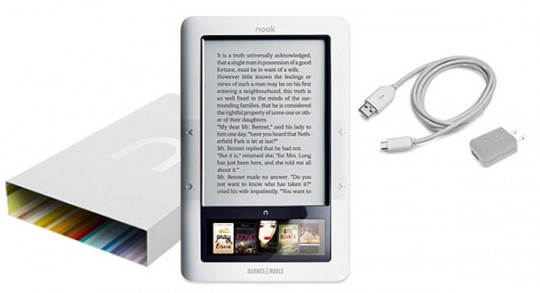
Barnes & Noble’s Nook: More Than the Basics


DON’T WRITE OFF Barnes
& Noble’s Nook (bn.com) as
just another e-reader. @is is
no thoughtlessly slappedtogether
oEering—it’s the
bookseller’s attempt to capitalize
on all the mistakes it
believes Amazon has made
with the Kindle, in the form
of a better product at the
exact same price.
In the Nook, all of the
things you’d expect—Wi-Fi,
an online bookstore, the
ability to mark notes—are
paired with unusual features,
such as a touchscreen, a color
navigation display, and a way
to lend e-books to friends.
Its $259 price is important
at a time when e-readers are
trying to break into the
mainstream. @ough Amazon
popularized e-readers,
rivals such as iRex, Plastic
Logic, and Sony are trying
to muscle in. Sony oEers
three diEerent models, with
progressively better features
and larger screens. @e other
two companies are vying for
customers with deep pockets,
oEering a magazine-style
experience on screens the
size of computer paper.
In contrast, the Nook is
geared toward the average
user. It isn’t a high-priced
business tool, and it isn’t
feature-deXcient, either. But
it does give the e-reader
market a kick in the pants.
Here are just a few of its
most intriguing features।
Big Battery, Decent Storage
BARNES & NOBLE claims that the Nook lasts ten days on a charge.
It’s not clear how the company arrived at that calculation and whether
Wi-Fi was on for the duration, but it’s safe to say that you could
take this device on a long flight. As for storage, the Nook’s 2GB can
carry up 1500 e-books, same as the Kindle.
Powering the Nook is Android 1.5. Users can stop reading on the
device and then resume on select BlackBerry and Motorola phones
with a free Barnes & Noble e-reader application. I also like the ability
to load photos onto the Nook to serve as screensavers.
Touchscreen Navigation
NOT ALL OF the Nook’s screen
is touchable. The top portion is
a regular E-Ink display, but the
bottom part is like the touchscreen
of a smartphone, allowing
you to navigate menus and
giving you a virtual keyboard for
typing in your notes.
By including a color touchscreen,
the Nook stands out
next to the bland gray hues of
other e-readers. When you
browse through your library,
the e-books scroll by in a way
reminiscent of the iPod’s Cover
Flow feature. The Nook also
works as an MP3 player.
The Form
THE NOOK MEASURES 7.7 by
4.9 by 0.5 inches, giving it similar
dimensions to the Kindle
(Amazon’s product is a little
taller and wider, but slightly
thinner). The actual screen real
estate, however, is the same 6
inches after you account for the
navigation touchscreen.
Accessorize!
IT’S NOT UNHEARD of to throw a
cover on an e-reader to make it more
book-like, but the Nook is getting
fancy with contributions from Kate
Spade New York, Jack Spade, Tahari,
and Jonathan Adler (pictured). With
Nook in hand, you just might become
part of the newest fashion trend. 

The State of Windows 7 Satisfaction

WINDOWS 7   IS only a few months old. Most people who will eventually use the new as haven't tried it yet; those who have are still set¬tling in. And things will change rapidly as bugs are squashed, missing drivers arrive, and compatibility wrinkles are ironed out. Even so, it isn't too early to start gauging what people think of Vista's replacement.
To do a reality check on the mostly favorable initial reviews for the new operat¬ing syste
(nno.pcworto.corm 64223), we at Technologizer (technoLogizer.com) decided to ask for opinions from our community, a group of tech
enthusiasts with a high pro¬pensity to acquire new ass quickly and to push them
to their limits. Starting on November 16, 2009, we sur¬veyed the site's readers (and Twitter followers) about their Windows 7 experiences. Positive Response About 615 Technologizer readers responded. A sizable majority said that they are extremely satisfied with the as and rate it as a clear improvement on both the beloved Windows XP and the widely panned Windows Vista. Crippling installation problems-always a legiti¬mate reason to postpone switching aSs-were rare
Prior to using Windows 7

46 percent of respondents ran Windows Vista; 32 per¬cent ran XP. Just 17 percent used Vista and XP about equally, 5 percent ran an as other than Windows, and 0.7 percent used a different version of Windows
Among those surveyed, 73 percent upgraded an exist¬ing PC to the final version of Windows 7, while 8 percent use a PC that came with the as preinstalled; 14 percent are working with a prerelease version, and 6 percent run it on a Mac via Boot Camp or a virtualizaticn program.
As for Windows knowl-

edge, 64 percent of respon¬dents rated themselves as expert; 35 percent said they were intermediate. Less than 1 percent were beginners
For 61 percent, Windows 7 is entirely or mostly for home or personal use; 25 percent are using it about equally for home and business. Just 14 percent are using it entirely or mostly for business.
Also, 61 percent of respon¬dents use a 64-bit edition of Windows 7; only 31 percent are running a 32-bit version.
A whopping 82 percent did a "clean" install ofthe as from scratch; 19 percent

?How did Windows Ts installation go
installed it over Vista
Finally, 59 percent report¬ed they've used Windows 7 extensively, and 36 percent said they've done so a fair amount. A scant 5 percent said they've used it a little.

It's important to note that our goal wasn't to survey a representative, projectable, normalized sampling of all Windows 7 users. The re¬sponses here are from mem¬bers of the Technologizer community who chose to take our survey. Their opin¬ions are their own-but we think the results make for interesting reading

Installing Windows 7 With ass, as with all things, first impressions count. And if you've purchased a new as as an upgrade, the first impressions it makes come during the course of the in¬stallation process.

Among survey takers who installed Windows 7, the number who ran into major hassles was very small, pre¬sumably in part because Windows 7 is so similar to Vista under the surface. The fact that the vast majority of respondents performed dean installations rather than installing on top of Vista surely helped, too.

In our survey, 84 percent said the process went off without significant hiccups; 13 percent said it went fairly well. Only 3 percent reported major problems, two-thirds of which were resolvable. Pretty impressive-when PCWorld surveyed Windows XP users shortly after that as shipped, half reported significant installation issues