This is default featured slide 1 title

Go to Blogger edit html and find these sentences.Now replace these sentences with your own descriptions.

This is default featured slide 2 title

Go to Blogger edit html and find these sentences.Now replace these sentences with your own descriptions.

This is default featured slide 3 title

Go to Blogger edit html and find these sentences.Now replace these sentences with your own descriptions.

This is default featured slide 4 title

Go to Blogger edit html and find these sentences.Now replace these sentences with your own descriptions.

This is default featured slide 5 title

Go to Blogger edit html and find these sentences.Now replace these sentences with your own descriptions.

Intel Core i7 –970


Until very recently, if you wanted a six­core Intel desktop processor, you had only one speed bin and model to choose from: the pricey 3.33GHz Core i7-980X Extreme Edition. However, in the past couple of months, Intel decided to intro­duce a slightly more affordable six-core chip, the Core i7-970.

This new hexa-core beast, like the 980X, is built on Intel's new 32nm process and clocks in not so far behind at 3.2GHz. Its top Turbo Boost speed is 3.46GHz, compared to the 980X's 3.6GHz, and its QPI link speed is set to 4.8GTps vs. 6.4GTps for the 980X, the latter of which won't hamper performance much, if at all. The 970 also has 12MB of shared L3 cache, just like its more expen­sive six-core sibling. Built with Intel Hyper-Threading technology, the chip is able to offer 12 threads of processing resources to the OS.

Also like the previous Core i7 six-core release, this chip will drop into existing Socket LGA1366 motherboards, though you might need to grab the latest BIOS update to support the new chip microcode. From a performance standpoint, for single­or lightly threaded workloads, the Core i7­970 lines up slightly behind a quad-core Core i7-975. However, in multithreaded applications that make use of the chip's extra cores, the Core i7-970 is up to 50% faster than its nearest quad-core counterpart and within about 5 to 7% of the 980X.

The Core i7-970 doesn't carry such an extreme price, retailing around $885, mak­ing it a great "budget" chip if you want six cores of Intel processing power .

Asus ENGTX460 OirectCU TOP

The GeForce GTX 460 from Asus came in too late to make it into last month's roundup, but we couldn't pass up the opportunity to get a closer look once we saw the angular heatsink shroud paint­ed blue with white pinstripes, evoking the iconic Shelby Cobra.

Under the hood, Asus overclocked the GF104's core clock to 775MHz, which is a full 100MHz higher than the stock clock of the 1 GB GTX 460. The memory clock also got a boost from 1,800MHz to 2,000MHz. The shroud covers a substantial aluminum finned heatsink with three heat­pipes, and as we hinted above, it's one of the more attractive we've seen. However, because of its open design, some of the heat this card generates ends up circulating throughout the case. But because the GTX 460 is the twice removed second nephew to the silicon-boiling big daddy that is the GF 1 00 Fermi, heat is not an issue you need to worry too much about. The backplane of this dual-slot card features a pair ofDVI ports and a mini HDMI port. Bundled extras include a 4- to 6-pin PCI-E power connector, a DVI-to-VGA adapter, a DVI­to-HDMI adapter, and a CD wallet.

In Win Dragon 81ayer

Meet an mATX mini tower in the vein of Frank Frazetta. This Dragon

Slayer is just an airbrushed side-panel mural away from total awesomeness.

In Win says that the hexagonally per­forated steel motif is meant to evoke chain mail. We see in it ye olde hex pa­per, much beloved among turn-based gaming nostalgists.

Breezy is the Dragon Slayer. Beyond its quartet of included fans, its perforated and filtered side panel has rubber mounting grommets for up to four more 120mm blowers. There's another paneled vent on the floor to accommodate your bottom­feeding power supply.


In Win pulls off a largely tool-less design here. The pin brackets for the drives have twist locks that are color-coordinated with the fan rotors, grom­meted drive rails, and expansion card retainers. The consensus around the lab calls the hue matte neon yellow, if not chartreuse


The front SuperS peed USB 3.0 connector termi­nates in a long cable meant to loop out the back through a rubber-lined hole, thence to mate with an unattached and suitably fast female port, such as on

the motherboard or a daughtercard.


two Hi-Speed USB ports and the usual HD/AC97 jacks round out the front gallery. Slaying any dragon requires adaptability, and thus In Win allows you to repurpose the drive bays in a number of ways. Rest assured that if you need to mount an SSD or prefer to use multiple burners, you're covered. The hardware packet even includes several incon­spicuous, peel-and-stick cable tamers .


by Marty Sems

Bigfoot Networks


Bigfoot Networks may not be a household name among general PC consumers, but in hardcore gaming circles the company's gaming net­work cards have earned a solid reputation, including the company's latest effort, the Killer 2100. Unlike "dumb" NICs that cause "huge, unpredictable latency spikes" during gameplay, Bigfoot states that the Killer 2100 "has latency in microseconds" thanks to its NPU (Net­ work Processing Unit) that offloads game data from the CPU and Windows. The card evidently impressed Alienware enough for the game system builder to announce in mid-August that it's offering the Killer 2100 in Aurora, Aurora ALX, Area- 51, and Area­51 ALX systems. Alienware's Frank Azor stated the NI C-system combo "represents a lethal combination-maximizing performance for more frags, faster leveling, and higher scores.


You know about Moore's Law and the power-consumption, pro­gramming, and architectural roadblocks making it more difficult to double the number of transistors on an integrated circuit approxi­mately every two years. So does DARPA. Thus, the agency recently announced a UHPC (Ubiquitous High Performance Computing) program that "directly addresses major priorities expressed by Pres­ident Obama's 'Strategy for American Innovation,'" including the exascale supercomputing Century Grand Challenge, energy-efficient computing, and worker productivity. With the goal to "reinvent computing," UHPC will involve developing "radically new computer architectures and programming models that deliver 100 to 1,000 times more performance" but are easier to program than present sys­tems. Intel, Nvidia, MIT, and Sandia National Laboratory have been tabbed to build UHPC prototypes by 2018.


Samsung's BD-C8000 ($499.99) may very well be the "world's first portable Blu-ray player with 3D capability," but don't get too excited just yet. Although the netbook-Iooking BD-C8000 will give you 1080P HD video on its 1O.3-inch screen, what it won't give you is 3D viewing while on the go. For that ability, you'll need to connect the player (HDMI 1.4a integrated) to a 3DTV. On the plus side, the BD-C8000 does build in Wi-Fi and is Netflix-ready. It also includes 1GB built-in storage and access to the various goodies that make up Samsung Apps (YouTube, Twitter, Flickr, Pandora, etc.). Battery life, meanwhile, is rated at three hours .

The Mac Pro Upgrades

Apple's desktop workstation, the Mac Pro, now features up to 12 CPU cores for what Apple says is a 50 percent performance improvement on its predecessor.

"In terms of the processor, we're adding Intel's latest generation Xeon technology, the Westmere generation of products," says David Moody, Apple vice president of worldwide Mac hardware marketing, referring to the Intel code name for the processor line. The new chips feature a 32-nanometer process that can fit up to six cores on a single die.

The new Mac Pro features a pair of either quad-core or six-core Intel Xeon processors, with up to a 12MB Level 3 (L3) cache and speeds ranging from 2.66GHz to 3.33GHz. "The combination of the cache and the integrated memory controller provides outstanding memory band­width and improved memory latency," Moody told Macworld.

The new Mac Pro also features Turbo Boost, which allows the system to dynamically boost CPU speeds up to 3.6GHz, and Hyper-Threading, which allows the system to create up to 24 virtual cores.

A first for the Mac Pro line, customers can slip a 512GB solid-state drive (SSD) into one or all four of the drive bays. By filling all four drive bays with SSDs, users can create a striped RAID.

The ATI Radeon HD 5770 graphics card with 1GB ofGDDR5 memory is now Custom Rig Apple says that there are 1.3 billion possible configurations of the Mac Pro.

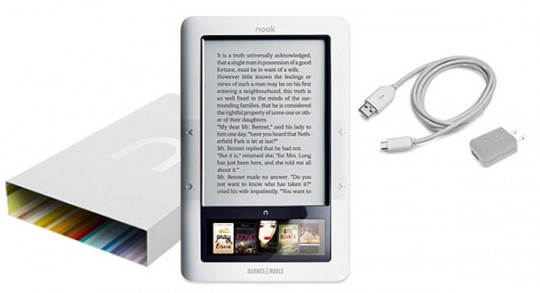
Barnes & Noble’s Nook: More Than the Basics


DON’T WRITE OFF Barnes
& Noble’s Nook (bn.com) as
just another e-reader. @is is
no thoughtlessly slappedtogether
oEering—it’s the
bookseller’s attempt to capitalize
on all the mistakes it
believes Amazon has made
with the Kindle, in the form
of a better product at the
exact same price.
In the Nook, all of the
things you’d expect—Wi-Fi,
an online bookstore, the
ability to mark notes—are
paired with unusual features,
such as a touchscreen, a color
navigation display, and a way
to lend e-books to friends.
Its $259 price is important
at a time when e-readers are
trying to break into the
mainstream. @ough Amazon
popularized e-readers,
rivals such as iRex, Plastic
Logic, and Sony are trying
to muscle in. Sony oEers
three diEerent models, with
progressively better features
and larger screens. @e other
two companies are vying for
customers with deep pockets,
oEering a magazine-style
experience on screens the
size of computer paper.
In contrast, the Nook is
geared toward the average
user. It isn’t a high-priced
business tool, and it isn’t
feature-deXcient, either. But
it does give the e-reader
market a kick in the pants.
Here are just a few of its
most intriguing features।
Big Battery, Decent Storage
BARNES & NOBLE claims that the Nook lasts ten days on a charge.
It’s not clear how the company arrived at that calculation and whether
Wi-Fi was on for the duration, but it’s safe to say that you could
take this device on a long flight. As for storage, the Nook’s 2GB can
carry up 1500 e-books, same as the Kindle.
Powering the Nook is Android 1.5. Users can stop reading on the
device and then resume on select BlackBerry and Motorola phones
with a free Barnes & Noble e-reader application. I also like the ability
to load photos onto the Nook to serve as screensavers.
Touchscreen Navigation
NOT ALL OF the Nook’s screen
is touchable. The top portion is
a regular E-Ink display, but the
bottom part is like the touchscreen
of a smartphone, allowing
you to navigate menus and
giving you a virtual keyboard for
typing in your notes.
By including a color touchscreen,
the Nook stands out
next to the bland gray hues of
other e-readers. When you
browse through your library,
the e-books scroll by in a way
reminiscent of the iPod’s Cover
Flow feature. The Nook also
works as an MP3 player.
The Form
THE NOOK MEASURES 7.7 by
4.9 by 0.5 inches, giving it similar
dimensions to the Kindle
(Amazon’s product is a little
taller and wider, but slightly
thinner). The actual screen real
estate, however, is the same 6
inches after you account for the
navigation touchscreen.
Accessorize!
IT’S NOT UNHEARD of to throw a
cover on an e-reader to make it more
book-like, but the Nook is getting
fancy with contributions from Kate
Spade New York, Jack Spade, Tahari,
and Jonathan Adler (pictured). With
Nook in hand, you just might become
part of the newest fashion trend. 

V3 Gaming PC Avenger


v3 Gaming PC is a new boutique startup that was created by employees who previously worked at Vigor Gaming. V3 Gaming tells us they're working with

vidia on its 3D Vision compliance, and by the time you see this review, it's likely V3 Gaming wiLl be selling systems with 3D Vision Surround capabilities. At press time, V3 offered three systems: the Avenger, the Convoy, and me Crave-with me Avenger being the top-of-the- line model.

Our Avenger is certainly a luxury build, as it features two Zowc GeForce GTX 480s in SLl and a Zowc GeForce GTS 250 for dedicated PhysX processing. Other lavish hardware includes an Intel Core i7-980X running at 4GHz, two 80GB Inrel X-25M SSDs in RAID 0, 6GB ofDDR3-2000 RAM, and an Antec Twelve Hundred case with a black vinyl wrap that both proteas and adds to the look of me system. V3 Gaming points out that you can remove the vinyl wrap and paint the base chassis if you prefer to mod me exterior of the system.

We found that the darkness of the black vinyl exterior, which is nonreflective, en­hanced the appearance of the blue light­ing effects inside the case. There are blue LEDs in the three 120mm fans in the front of the case, me two 120mm rear exhaust fans, and the 200mm fan at me top of the case. The mass of lights created a dim blue haze over the syscem interior, Cable routing was smartly done, and we like mat me builder covered some of me brighdy colored cables with electrical tape .

V3 Gaming performs both me over­clocking and RAID setup as a free ser­vice. The Avenger sent to us featured an Asus PGX58D-E motherboard with a GGbps SATA interface, and with the Intel

X-25M RAID 0 setup, me sys­tem was able to deliver a 308.4GMbps transfer speed in me Physical Disks test of SiSorrware Sandra 20 I 0 Lice. The Avenger was a strong gaming PC, with 81. 7 fps in Dir 2, 10G.97fps in Far Cry 2, and 42.4fps in STAL.K.E.R.: Call OfPripyar.

Our only qualm with the Avenger was the amount of heat coming from the graphics cards. We would have expect­ed a fan on the side panel near the graphics card, but V3 Gaming opted not to use one. And when we put our hand on the Avenger's side panel, we could feel that the whole side panel was warm. That being said, we didn't experience any overheating issues during our benchmarking or burn-in tests, and V3 Gaming backs every sys­tem with a three-year warranty.

Performance of me Avenger was top­notch, and we like that V3 Gaming offers overclocking free, a practice mat some boutique builders have gone away from. We also expect that V3 Gaming wiLl offer a wider variety of systems in the near future